Shared Spaces and the Work of Belonging
A stewardship proposal for a shared reading room, with fair booking choices, practical rules, ways to resolve competing uses, and clear privacy boundaries.

A shared room has several lives. It may hold a quiet reading group in the morning, a repair table after lunch, and a neighborhood conversation in the evening. Each activity can be worthwhile. The difficulty begins when one group's ordinary habits become the room's unwritten rules.
Belonging, as a proposal for managing such a room, should mean being able to understand its use, request a place, raise a concern, and leave without surrendering unnecessary personal information. It need not mean knowing the regulars, joining a group, or enjoying every activity. A person can belong while reading alone.
Public libraries offer useful professional thinking about this problem. The American Library Association's discussion of meeting spaces supports equitable access regardless of a group's beliefs or affiliations. This is an organizational position that helps frame a stewardship question; it is not, by itself, a determination of what law requires in any particular building. ALA's guidance on meeting rooms and programs provides that perspective.
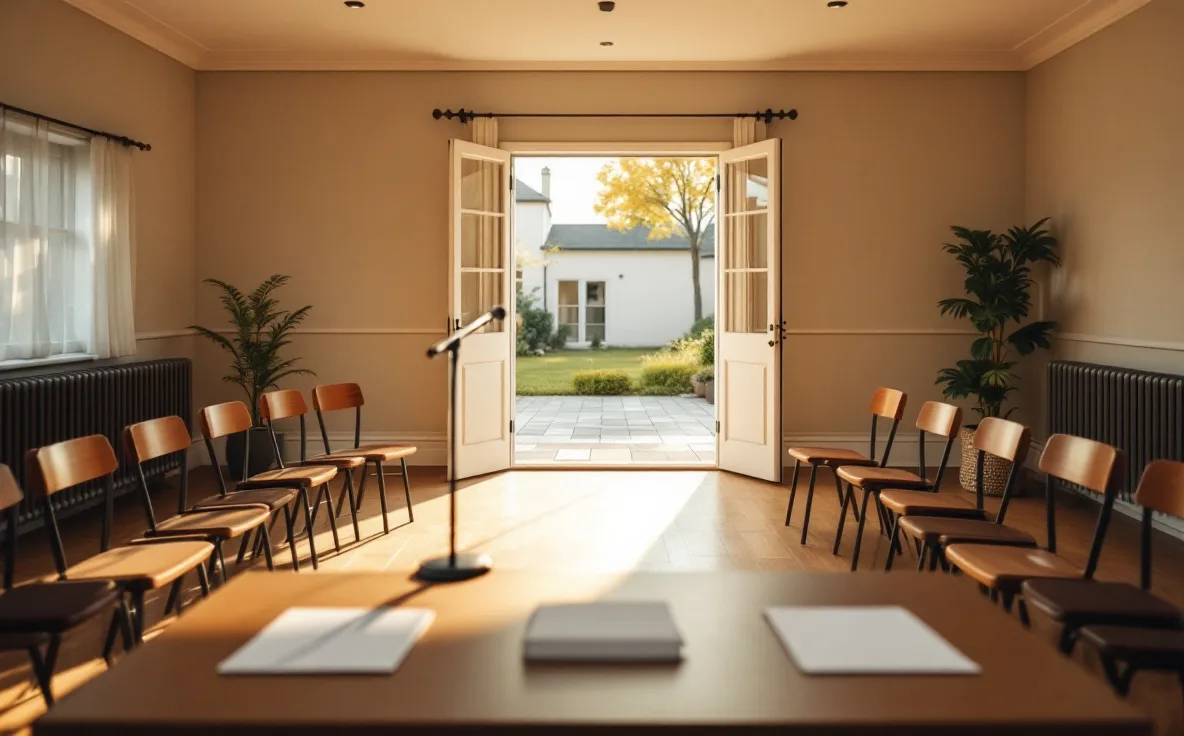
The proposals here concern a fictional community reading room with one bookable side room, an open reading area, and a small entrance lobby. Every conflict and arrangement described is hypothetical. The setting combines concerns that readers can explore further through Community Life and Books and Ideas.
At the entrance: make the room understandable
A newcomer should be able to answer three questions without interrupting a busy staff member: what can I do here, which spaces are available, and where can I ask for help? For the hypothetical reading room, a short entrance notice could identify open seating, the bookable room, and a staff contact. It should also say whether ordinary use requires registration or payment.
The notice should describe activities rather than sorts of people. A quiet reading area is a usable instruction. A demand that everyone behave appropriately leaves newcomers guessing whose habits define appropriate conduct. Write observable expectations: keep calls outside the reading area, leave the circulation route clear, and ask before moving shared equipment.
Make orientation optional. A staff member can offer a brief explanation without insisting on a tour or asking why the person has come. Some visitors want conversation; others want a chair and a book. Hospitality should leave room for both.
The physical arrangement should support that choice. In this proposal, place information about groups near the entrance but preserve a route to ordinary seating that does not pass through a membership table. Joining an activity can be an invitation, while using the room remains an ordinary act.
At the booking desk: ration scarcity openly
A single side room cannot satisfy every request. Before allocating it, decide what the booking system is trying to preserve. For the fictional space, the proposal is a mix of recurring activities and opportunities for people who are not already established users.
Reserve some sessions for advance booking and some for shorter-notice requests. Limit how many recurring sessions one group can hold before review. Publish the same information at the desk and online, and allow a person to request a slot without navigating an online account. The precise allocation should follow the room's capacity and purpose, rather than being presented as a universal formula.
Consider two hypothetical requests. A reading group has used the same evening for months. A new language exchange wants that evening because its participants work during the day. Automatically protecting the established booking makes familiarity a permanent advantage. Automatically displacing it would disregard people who planned around an accepted arrangement.
A proposed response is to honor the existing booking through its stated term, then review competing requests under a published rule. Alternate sessions, shorter booking terms, or a transparent draw between equally eligible requests may be options. Explain the choice and give each group a route to question an error.
Do not settle the conflict by asking which activity is more socially valuable. That invites the desk to judge the worth of unfamiliar interests. Instead, check the stated use, room requirements, available times, and allocation rule. If an exception is necessary, record the reason and consider whether others in similar circumstances should receive it too.
Between the rooms: resolve incompatible activities
The hypothetical repair group needs conversation and occasional equipment noise. A reader nearby needs quiet. Neither preference disappears because the organization celebrates community. The question is whether the space can host both activities under conditions that people can reasonably understand.
Try the least disruptive practical arrangement first: close the side-room door, move noisy work away from the shared wall, or schedule the loudest task for a clearly advertised period. Ask the affected users whether the proposed arrangement addresses the difficulty. Do not claim that a sign has solved a sound problem.
Use an operational comparison like this for the fictional room:
| Situation | First response to test | What needs review |
|---|---|---|
| Repair noise reaches the reading area | Move the noisy task and test audibility | Whether another session or room is needed |
| A group leaves chairs across the route | Clear the route and explain the layout | Whether storage and setup instructions are adequate |
| Two bookings overlap | Check the booking record and speak to both groups | Whether confirmation messages caused the error |
| A regular challenges a newcomer's presence | Restate ordinary access and offer staff help | Whether informal gatekeeping has become routine |
These are suggested responses, not a promise that every conflict has a compromise. If the room cannot support a particular activity safely or within its stated purpose, say so and explain the specific constraint. Avoid presenting the decision as a verdict on the people proposing it.
The same care applies to complaints about discomfort. Ask what happened. Unfamiliar clothing, an accent, or a group's identity should not be treated as evidence of disruptive conduct. Conversely, a group's popularity should not excuse blocking access or repeatedly ignoring agreed limits.
A short rule sheet with a repair process
For this fictional space, the following six rules form an original starting proposal. Staff and users would need to test them against the room's actual operation:
- Use open seating without joining an activity. Leave space for others and keep designated routes clear.
- Follow the posted activity conditions for each area. Ask staff if two activities interfere with one another.
- Book the side room through the published process. A regular booking ends at its stated review point.
- Ask before photographing or recording identifiable people as part of an organized activity. Discuss access-related recording requests privately with staff.
- Return shared equipment and report damage or missing items. Explain problems promptly rather than leaving them for the next group.
- Raise a concern with the named staff contact. A person affected by a restriction may ask for the reasons and a review.
The repair process matters as much as the list. If a hypothetical group leaves the room untidy, begin with a description of what must change and a chance to correct it. A repeated failure may require a booking condition or restriction. Specify its scope, duration, and review point; avoid an indefinite penalty hidden in staff recollection.
Urgent situations may require immediate action under the venue's established safety procedures. The ordinary rule sheet should identify where that responsibility sits. It should not imply that staff must continue negotiating while someone faces immediate harm.
Keep responses consistent while accounting for relevant circumstances. Someone who did not understand a booking message may need a clearer explanation. Someone who understood and repeatedly ignored it may require another response. Record those reasons so that flexibility is explainable rather than dependent on personal favor.
At the information desk: collect less about people
Room stewardship can drift into unnecessary observation. An organizer wants attendance figures; a donor wants stories; a committee wants to know which groups return. Combining these requests can create a record of people's associations that ordinary room management does not need.
ALA's privacy interpretation includes records of using library programs and facilities within its discussion of confidentiality. It also opposes unjust surveillance of library users. Those are professional commitments worth considering separately from any question about local legal obligations. ALA's Privacy interpretation states the position.
For the fictional room, count occupied seats at selected times without recording who sits in them. Ask a booking group for one responsible contact and the operational details needed for the reservation. Do not routinely demand a list of everyone who attends or search their public profiles to judge the booking.
Choose a retention period for booking contacts and explain it. Keep incident records limited to relevant facts, restrict access, and avoid adding speculation about motives. A report that someone moved chairs into an exit route is operationally useful; an amateur character assessment is not.
Publicity should have its own permission process. If a group wants photographs, provide an arrangement that allows ordinary users to avoid appearing without leaving the building. A blanket notice at the entrance should not be the only thought given to people who came to read privately.
At closing time: judge the arrangement, then change it
A stewardship review should consider who can use the room under its present rules. Look at refused booking requests, unresolved access concerns, cancellations, setup burdens, and complaints about inconsistent treatment. Attendance alone cannot explain why an activity is absent or why a newcomer did not return.
Invite feedback through more than the regular users' meeting. In the hypothetical room, a paper response box, private conversation, and simple online form could offer different routes. Ask concrete questions about booking, finding information, and using the space. Nobody needs to supply a personal account of exclusion to suggest a clearer sign.
Give the review a visible result. Perhaps recurring bookings become shorter, chair storage changes, or the room description makes noise conditions clearer. Explain what changed and why, while keeping individual complaints private. If a suggestion cannot be adopted, state the constraint rather than thanking the person into silence.
Before locking up, imagine the first visit of someone who knows none of the regulars. They should find the same published conditions, booking opportunities, and help routes as everyone else. The room's promise becomes credible through that ordinary encounter: a place to sit, an understandable rule, and someone willing to correct an arrangement that is not working.

Marisol Fenwick
Editorial pen name. Community life and everyday civic participation.
Revised 28 October 2026